
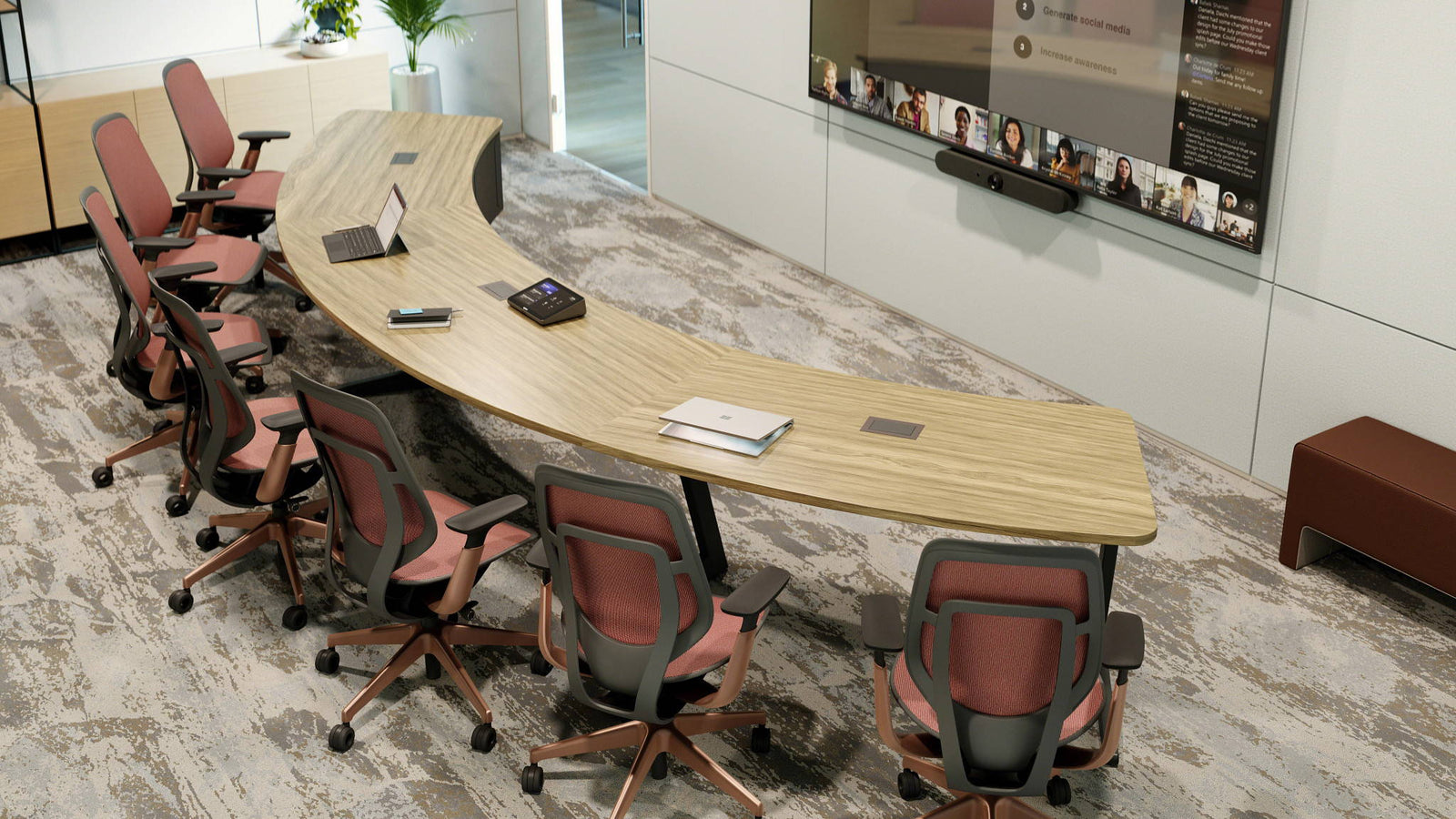
This guide is for optimizing meeting spaces with Signature Microsoft Teams Rooms solutions and devices. It covers Signature Teams Rooms requirements, devices, solutions, layouts, installation, and specifications.
Quick answer: A Signature Microsoft Teams Room is built around a curved table with everyone seated on one side, facing a single ultrawide 21:9 front-of-room display running the Front Row layout, with an ultrawide intelligent camera, certified microphones and speakers, and an acoustically treated room. Microsoft's reference sizes are a large room of 25 ft x 14 ft for 6–8 people and a small room of 18 ft x 12 ft for 4–6 people. Signature rooms complement, rather than replace, standard Teams Rooms, and are best deployed where high-touch, face-to-face interaction matters most.

In this guide, we explore how Microsoft is transforming standard conference rooms into Signature Microsoft Teams Rooms that give Teams Rooms users the best front-row experience possible. The guide provides room design, technology guidelines, installation practices, recommended products, and Microsoft reference specifications. For how to size and standardize a whole portfolio of rooms, see our Deploying Microsoft Teams Rooms buyer's guide, and for license tiers see Basic vs. Pro.
Microsoft's vision for the future of Teams meeting rooms
In the near future work will be fluid, dynamic, and powered by the cloud. At any time, from anywhere, Microsoft enables meeting experiences that allow people to be present. As these are hybrid meetings, you can participate in them seamlessly no matter where you are located. With devices designed for Signature Teams Rooms, meetings are inclusive; everyone's voice is heard, and everyone has a clear voice.
Microsoft sees a future in which immersive meeting spaces and environments are designed around those who use them. It is now possible for everyone, wherever they are, to connect face-to-face with each other. There is no better way to keep everyone connected to the content and to each other than with a dynamic meeting experience: formal presentations are blended with collaborative chat conversations, and creativity is unleashed when groups use a digital canvas.
The vision for the future is based on a simple idea: meetings must offer more than one-time transactions to participants. Whether people are in a room or worldwide, meetings will be tailored to their needs.
What is a Signature Teams Room?
The needs of both remote and in-person participants drive room standards in Microsoft's hybrid workplace. The Signature Teams Room is designed to provide an elevated hybrid meeting experience, fostering more natural and immersive connections while helping participants feel included, represented, and productive. Using software and hardware capabilities in conjunction with guidance on room configurations, Signature Teams Rooms make a set of principles a reality.
A Signature Teams Room is a concept developed around a set of experience principles, which are based on a set of important goals.
Goal 1: Everyone in the meeting feels included, represented, and productive.
Design principles:
- Remote participants can establish a genuine presence in the room.
- In-room participants can retain their individual identities in the meeting.
- All meeting participants can engage in boundaryless collaboration.
Goal 2: Connections feel natural and immersive.
Design principles:
- Experiences are scaled for human connection, enabling interactions that feel like everyone is in the same room.
A Signature Teams Room experience is all those components and ideas put together, with no single feature defining the experience. The individual characteristics and concepts found in Signature Teams Rooms may also be deployed independently. Examples of specific feature deployment:
- Take advantage of the front-row, front-of-room display experience in all types of meeting spaces where a Microsoft Signature Teams Room solution supports it.
- Implement and update rooms with curved tables and front-facing layouts alongside traditional Microsoft Teams Rooms experiences to promote better human connection while maintaining continuity of experience across all meeting spaces.

When should you deploy a Signature Teams Room?
Signature Teams Rooms are not intended as a replacement for all other meeting spaces in your organization, but rather as a complement to existing meeting spaces using Microsoft Teams Rooms. Deploy them strategically at locations and spaces where high-touch, face-to-face interaction is most valuable.
Microsoft Teams Rooms will continue providing people-centric hybrid meeting experiences through new technology and continuing software updates. It is essential, however, to follow room configuration guidelines and implement hardware technologies to optimize Signature Teams Room experiences. There are several components of a Signature Teams Room, but their combination creates the complete Signature Teams Room. Several factors help determine how many of your Teams Rooms to evolve into Signature Teams Rooms:
- Is a high-touch conversation required?
- Room dimension and capacity are closely related in most conference rooms, which maximize valuable square footage. Rather than maximizing square footage, a Signature Teams Room prioritizes the meeting experience. It is not possible for every organization to prioritize this way for every meeting space, as it may reduce the number of meeting rooms available.
- Are there any hardware upgrades or investments to be made?

Understanding the Signature Teams Room space
Balancing hybrid flexibility with inclusion:
Flexible work guidelines at Microsoft headquarters prioritize employees' choice and flexibility about where and when they work. Microsoft has rethought the evolution of its meeting spaces and technology because of this fundamental shift in policy.
In research studies, remote meetings during the pandemic have been shown to have many benefits, including increased feelings of equity and inclusion. As organizations consider returning to a hybrid workspace setting, where remote and in-person collaboration happens simultaneously, Microsoft created meeting spaces that better support flexible work policies while maintaining a level playing field for all participants through room design and technology.

What is this space used for?
For small and medium-sized groups, this signature space provides the most immersive experience for working together as a team.
Signature Microsoft Teams Rooms provide a unique environment where meeting participants can meet remotely and locally, presenting and co-creating content easily, just like in a typical Microsoft Teams Room.
How is a Signature Teams Room space laid out?
The key to making the room so effective is a configuration that allows remote participants and content to be seen and engaged with in the best way possible.
During a presentation, all chairs in the layout are aligned with the display, which enables remote participants to see what is going on. The curved table also facilitates eye contact and assists in-person participants in orienting themselves.

How does the audio work?
Using Microsoft Signature Teams Rooms certified audio solutions, it is possible for people to hear and be heard clearly. Auto-tracking microphones enhance the conversation and reinforce real-time participation no matter the location in the Signature Microsoft Teams Room.
In the future, Signature Teams Rooms will support audio systems that use spatial audio. With spatial audio, sound emanates from the direction of the person speaking. For example, if a person on the right side of the meeting gallery speaks, the audio will come from the speaker closest to that location. This immersive audio experience helps meetings more closely resemble an in-person conversation.
How does the camera work?
An ultra wide-angle HD camera is recommended for this space. It is positioned at the front of the room below the displays to capture everyone in the space.
The ultrawide-angle camera features intelligent tracking of meeting participants so they can be represented individually in a large view instead of as faces within a large image of the entire room. For larger rooms, Q-SYS VisionSuite is certified for Microsoft Teams and adds AI presenter tracking.
How do you engage with front-of-room displays?
This Signature room is optimized for the Microsoft Teams Rooms layout called Front Row and is displayed through a specialized short-throw high-resolution projector or ultrawide display. This allows participants to be near the screen, enabling better communication and engagement, and creates an immersive front-of-room experience designed specifically for Signature Teams Room meetings.

What is Microsoft Front Row?
A content layout called Front Row was introduced for Microsoft Teams Rooms to enhance the sense of connectedness between participants and support collaboration. This layout allows participants to see remote colleagues face-to-face across a horizontal plane, much as if they were in the same room. As a result of this layout, the video gallery has been moved to the bottom of the screen, and its ratio has been fixed to keep the faces as large as possible.
A meeting's content is surrounded by contextual, fluid elements, such as the agenda, tasks, and notes, which can be updated in real time, allowing participants to remain engaged and collaborative. These contents are displayed on wide-aspect-ratio screens in Signature Teams Rooms to maximize meeting content size and participant capacity. Furthermore, the meeting chat is clearly visible when joining a meeting from a Signature Teams Room so that you can participate in the conversation in real time.
A single- or dual-display configuration can be used with this layout. Even though Front Row is particularly effective in Signature Teams Rooms, it can be used in any Windows Teams Room regardless of hardware configuration or furniture layout.
How do you co-create content?
With Signature Microsoft Teams Rooms, users can capture traditional analog whiteboards using the intelligent capture feature to get the best of both worlds. Microsoft Whiteboard can be accessed using a touchscreen monitor at the front of the room, mobile devices like a PC, smartphone, or tablet, and the Microsoft Surface Hub to provide a more modern experience where participants can draw and ink together.

Signature Teams Room design guidance
This section describes the requirements to design and build a Signature Microsoft Teams Room from the ground up.
Signature Teams Room layout and design
Optimal room size standards
| Room size | Dimensions | Capacity | Furniture |
|---|---|---|---|
| Large | 25 ft x 14 ft | 6–8 people | Curved table with participants seated on one side; standard 30 in (76 cm) table height |
| Small | 18 ft x 12 ft | 4–6 people | Curved table against the long wall, participants facing the display; standard 30 in (76 cm) table height |
Large room (25 ft x 14 ft). This Signature Teams Room is optimized for 6–8 people. The curved table has participants seated on one side, allowing in-room participants to retain visibility of each other and be positioned face-to-face with remote participants.

Small room (18 ft x 12 ft). This small Signature Teams Room is optimized for 4–6 people. The curved table sits against the room's long wall with participants seated facing the display, allowing in-room participants to retain visibility of each other and be positioned face-to-face with remote participants.

Equipment mounting
The hardware location is typically determined by the Teams Rooms-certified hardware used within the meeting space.
For the initial deployments of Signature Teams Rooms within Microsoft facilities, Microsoft chose to mount the Teams Rooms compute and touch console at the table, with a built-in camera and soundbar (equipped with discrete left- and right-channel audio for spatial audio) mounted on specialized furniture below the displayed image, between the front-of-room projection and the table. High-resolution short-throw projectors or ultrawide displays are used for the display. Participants should be able to access the touch screen console without restricting their ability to use the table for personal devices or documents.
This type of meeting room allows participants to share content via personal devices by joining the Teams meeting. Local video presentations should also be provided at the table in an easy-to-access manner for those who cannot join the conference call.
Touch screen placement
The Signature Microsoft Teams Rooms touch screen should be located in the center of the table within easy reach of meeting participants without blocking usage of the table for personal devices or documents.
Local video presentation
Though many participants may choose to share content by joining the Teams meeting from a personal device, the in-room local video presentation should also be available at the table in an easily accessible manner.
Contact us for expert guidance

Signature Teams Room infrastructure requirements
Infrastructure power
At a minimum, electrical power connections should be provided at the table (for end users), behind the display, and at the equipment mounting location. If co-create devices are used in the space, electrical power connections may also be required at their location.
Infrastructure data
Networking connections should be provided at the table (for end users), at the display, and at the equipment mounting location (for the main network for the Teams Rooms solution). If co-create devices are used in the space, network connections will also be required to connect to the main network for the Teams Rooms solution.
Acoustic wall treatments
At least two walls in a room of this type should be acoustically treated to prevent echo and ambient noise issues during meetings. The best acceptable room sound levels are between 25–35 dB.
Window treatments
Light from windows in a room of this type may negatively affect the lighting and introduce glare and shadows to both the camera image and the front-of-room display. Any space featuring windows should also feature window treatments allowing external light to be blocked during meetings.
Floor treatments
To prevent echo and ambient noise issues during meetings, the floor in a room of this type should be cushioned, carpeted, or otherwise treated so that it can be acoustically efficient.
Lighting
An overhead lighting system with dimming capability should be provided to illuminate the space evenly, with meeting room participants not appearing washed out or sitting in a dark area. Efforts to minimize direct lighting on front-of-room displays, co-create devices, or other reflective surfaces within the space should be taken to avoid introducing glare.

Signature Microsoft Teams Room technology guidance
Signature Microsoft Teams Rooms solutions
Signature Teams Rooms require the use of Microsoft Teams Rooms on Microsoft Windows.
Cameras
Camera options. A room of this type requires an intelligent, ultrawide-angle front-of-room HD camera that is appropriately rated for the width and depth of the space.
Camera placement. The HD camera should be placed at the front of the room below the front-of-room projection but above the top of the table to capture all the meeting room participants at as close to eye level as possible.
Microphones
Microphone options. Certified front-of-room microphone arrays, tabletop, and overhead microphones will work for this type of space.
Microphone placement. Microphone arrays must be positioned to provide coverage for all meeting room participants within the certified range of the device.
Speakers
Speaker options. Front-of-room speaker arrays and overhead speakers will work best for this type of space. Note: spatial audio is not yet certified and may require specific audio devices.
Speaker placement. Speakers must be positioned to provide coverage for all meeting room participants within the certified range of the device or devices used.
Front-of-room display
Display type. A room of this type requires an ultrawide aspect ratio, high-resolution front-of-room display that is appropriately sized for the width and depth of the space to ensure maximum visibility and clarity. Example display types include:
- Epson 21:9 ultrawide laser projectors
- 21:9 LED video walls
- 21:9 ultrawide LCD or OLED flat panel displays
Display functions. Signature Teams Rooms, as with all other Microsoft Teams Rooms solutions, require displays that can accommodate the following features for proper operation:
- Sleep and quick wake-up from sleep based on HDMI sync. Displays must support the appropriate EDID and resolutions required by the Microsoft Teams Rooms design. For projectors, automatic warm-up and cooldown periods must be supported without required user intervention.
Display placement. A Signature Teams Room requires that the display is placed in front of all the in-room meeting participants, directly opposite the table. The horizontal center line of the display must be centered on the same center line as the table. The vertical center line of the display must be no more than +/- 15 degrees offset from the eye line of a typical in-room meeting participant seated at the table.
Display count. A Signature Teams Room requires that the display is either a single wide-aspect-ratio display or a blended combination of displays that can achieve the effect of being a single display when seen by in-room meeting participants.
Collaboration options
Microsoft Whiteboard. All Teams Rooms can take advantage of Microsoft Whiteboard through an interactive collaboration device such as a Microsoft Surface Hub, a touchscreen side-of-room display, and companion devices like a PC, phone, or tablet.
Traditional whiteboard. All Teams Rooms on Windows can use traditional whiteboards in Teams meetings through the intelligent capture feature and a secondary content camera.

Signature Teams Room recommended products
Microsoft Teams Rooms touch console and computer
- A Windows-based Microsoft Teams Rooms solution.
- A Microsoft Teams Rooms license.
- Crestron Flex customizable conference system
- Crestron Flex customizable conference system Advanced
Cameras
- An ultrawide HD camera with intelligent framing.
- Jabra PanaCast 50
- Huddly L1
- Poly Studio X30
- Poly Studio E70
- Logitech Rally
- Logitech Rally Bar
- Logitech Rally Bar Mini
Microphones
- A certified microphone solution that will clearly capture all the in-room meeting participants.
- Biamp Devio conference room hub with Parlé ceiling mic
- Biamp Devio conference room hub with Parlé table mic
- Shure MXA710-4FT wall-mount audio system
- Nureva HDL300 audio conferencing system
- QSC meeting room audio: in-ceiling speakers
- QSC large room: directional audio, ceiling audio
- QSC meeting room audio: pendant speakers
- Biamp audio with Parlé ceiling mic
- Biamp audio with Parlé tabletop mics
- Shure Microflex Advance MXA920 + IntelliMix P300
- Biamp Tesira DSP and Sennheiser TeamConnect Ceiling 2
Speakers and audio systems
- A certified speaker solution that will provide clear and intelligible audio to all the in-room meeting participants.
- Poly Studio
- Lenovo ThinkSmart Bar
- Lenovo ThinkSmart Bar XL
- The Biamp, Shure, Nureva, and QSC audio systems listed above also serve as speaker solutions.
Displays
A 21:9 ultrawide 5K display, or a short-throw or ultra-short-throw laser projector with high resolution and high brightness, automatic wake on sync, and cool-down during sleep. A low-gain projector screen with ambient-light-rejecting properties will provide the best picture quality in bright rooms.
- Jupiter Pana 105 21:9 ultrawide display
- Avocor L Series 105" 21:9 ultrawide display
- Epson EB-PU1007 projector with ELPLX01S ultra-short-throw lens
- Da-Lite UTB Contour screen, HD Progressive 0.6, CinemaScope 138" diagonal
Other options: For the ideal scenario, other display options (alternate projectors, LED walls, and flat panel displays) should be able to create a table-spanning image, support a 4K image, and a 21:9 aspect ratio.
Collaboration options
- An analog whiteboard with a content camera, or
- A compatible interactive touch display.
Content cameras:
Interactive touch devices: Microsoft Surface Hub 2S
Furniture: Stand for Signature Teams Rooms, Heckler; Ocular table by Steelcase

Learn more about Microsoft Teams Rooms
The Signature Teams Room installation process
The design and installation process is critical to building a Signature Teams Room. It includes installing specific equipment, such as HD video cameras, an audio system, projectors, or ultrawide displays. This is the overview of the installation process, including site preparation, equipment installation, and testing.
Firstly, design the room and install proper infrastructure, including electrical and data. Next, the video cameras need to be installed to provide high-quality video conferencing. This requires careful placement and calibration to ensure all participants are visible at the optimal camera angle.
Secondly, an audio system is installed to provide clear and high-quality sound. This involves selecting the appropriate microphones, speakers, and sound systems to ensure everyone can be heard clearly.
Next, the ultrawide display is installed to provide an immersive and collaborative meeting experience. These displays need to be appropriately mounted and calibrated to provide clear and accurate visuals. Throughout the installation process, it is crucial to work with a certified Microsoft partner who can provide expert guidance and ensure that the installation meets all of the organization's needs.
Then install the furniture in the Teams Room and complete the acoustic wall treatment.
Deployment support includes a planning meeting, installation and configuration, and a half day of remote configuration support. Testing and room commissioning are performed onsite as part of the installation.
By following a well-planned installation process, organizations can ensure that their new Signature Teams Room runs smoothly, providing a productive meeting experience for all participants.
Read more: Microsoft Front Row fuels Draper's expansion into 21:9 screens
Read more: How Microsoft's Signature Teams Rooms Enhance Meeting Experiences
Buy now: Certified Microsoft Signature Teams Room Front Row 21:9 Ultrawide Video Conferencing Solution
Creation Networks, Inc. — nationwide commercial AV integrator, CTS-D certified, headquartered in Incline Village, NV with a California office in Concord. Design, engineering, programming, installation, and support from a single point of contact since 2006. Call 888-230-3661 or email sales@creationnetworks.net.
Get Started
Let's Talk About Your Signature Teams Room
Send us your room dimensions and how you want to meet. A CTS-D engineer reviews the space and recommends the right Signature Teams Room design, usually within one business day.


