
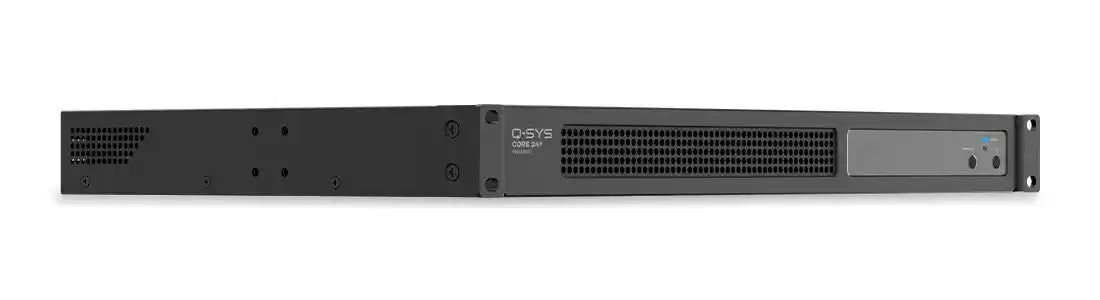
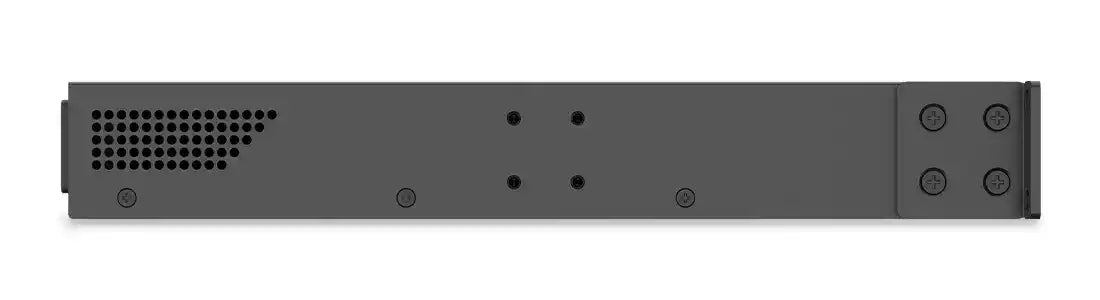

QSC Core 24f – Q-SYS Next-Generation Network + Analog AV&C Processor

QSC Core 24f – Q-SYS Next-Generation Network + Analog AV&C Processor is backordered and will ship as soon as it is back in stock.
Shipping Availability*
Shipping Availability*
Free Ground Shipping on Most Orders Over $250.00
Looking for the best price or expert advice? Give us a call at 1-888-230-3661 or use the Live Chat below. Buying 1 or 100, you may qualify for greater savings beyond the advertised price.

QSC Core 24f – Q-SYS Next-Generation Network + Analog AV&C Proc...

What is the QSC Core 24f?
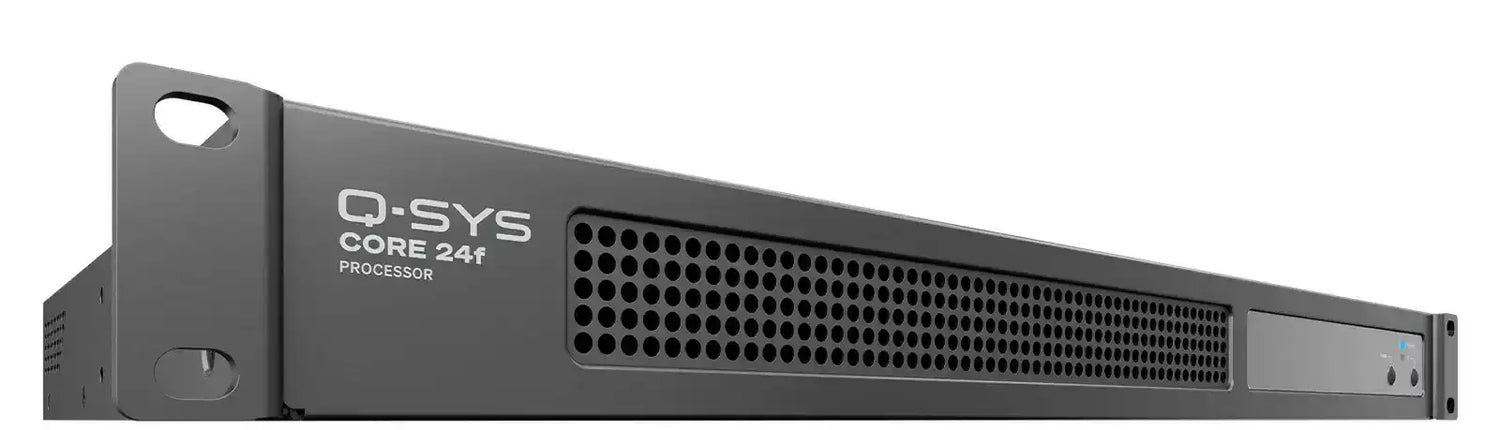
The QSC Core 24f is the current-generation successor to the Core 110f, delivering the next evolution of Q-SYS audio, video, and control (AV&C) processing in a 1U full-width rack-mount chassis. Designed for medium to large commercial deployments across corporate, higher education, hospitality, and entertainment environments, the Core 24f significantly expands on its predecessor: 160×160 Q-LAN/AES67 network audio channels, 24 analog I/O ports including 8 software-definable Flex channels, 24 channels of acoustic echo cancellation (AEC), and native USB-C AV bridging at 16×16 channels with 24-bit depth. Four network ports — two 2.5 Gbps multimedia and two 2.5 Gbps auxiliary — provide both redundant AV transport and segregated service routing for VoIP, SNMP, and media streaming.
Product Description

A key advancement over the Core 110f V2 is the inclusion of the full Q-SYS Control engine without requiring feature licenses for core control functionality — UCI deployment, scripting, and third-party device control are all available natively. The Core 24f supports up to 8 VoIP softphone instances, 8 Q-SYS NM-T1 beamforming microphones, up to 96 network peripherals, and includes an onboard 128 GB media drive with 64×64 Dante expansion capability (licensable up to 64×64). An OLED front-panel display, GPIO (8×8), and dual RS-232 ports round out the I/O complement for integrators transitioning from card-based DSP platforms.
Key Features
- 160×160 Q-LAN/AES67 networked audio channels — 25% more network capacity than the Core 110f V2, supporting larger distributed audio architectures.
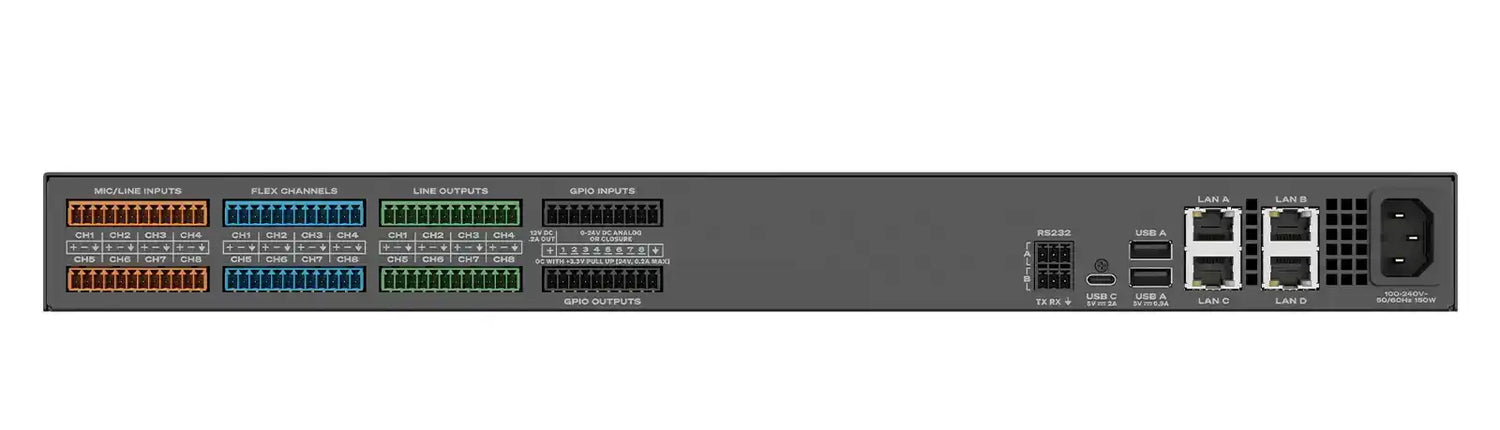
- 24 analog I/O with 8 software-definable Flex channels — 8 mic/line inputs, 8 line outputs, and 8 Flex channels independently configurable as mic in, line in, or line out.
- 24 channels of acoustic echo cancellation (AEC) — 50% more AEC than the Core 110f V2; accommodates larger multi-microphone conferencing deployments without supplemental DSP.
- USB-C AV bridging (16×16, 24-bit, 48 kHz) — Higher resolution bridging than the previous generation; supports up to 3 simultaneous USB audio device connections with HID routing.
- Four 2.5 Gbps Ethernet ports — Two multimedia ports for redundant Q-LAN/AES67 transport; two auxiliary ports for isolated VoIP, SNMP, LDAP, and WAN media streaming traffic.
- 8 VoIP softphone instances — Double the VoIP capacity of the Core 110f V2; suited for multi-zone PSTN integration or high-traffic conferencing environments.
- Full Q-SYS Control engine without core feature licenses — UCI deployment, scripting, third-party RS-232/GPIO/IP device control, and automation available out of the box.
- Supports up to 8 Q-SYS NM-T1 beamforming microphones — Native tabletop microphone ecosystem integration without additional DSP or audio interfaces.
- 8×8 GPIO + 2 RS-232 ports — Onboard control connectivity for projectors, shades, lighting, HVAC, and other third-party room devices.
- 128 GB onboard media drive — Supports 4-channel recording and up to 64-channel playback (expandable to 128 with optional license); approximately 200+ hours of mono WAV storage.
- Up to 96 network peripherals — Three times the peripheral capacity of the Core Nano and Core 8 Flex, supporting large enterprise installations.
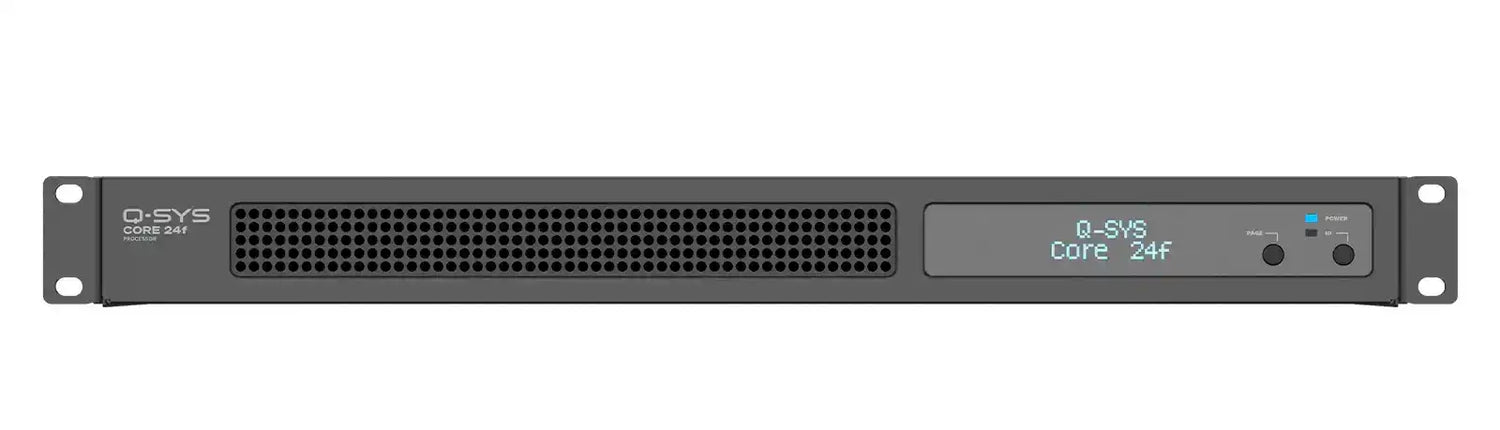
- OLED front-panel display — Restored in the Core 24f after removal from the Core 110f V2; shows network status, IP addresses, and system identifiers.
Typical Applications
- Boardroom
- Conference room (medium to large)
- House of worship
- Government space
- Commercial meeting space
- Multi-purpose room
- All-hands room
- Training room
- Higher education AV deployment
- Auditorium
Technical Specifications
| Specification | Value |
|---|---|
| Q-LAN / AES67 Channels | 160 × 160 |
| Dante Channels | 8×8 included; licensable to 64×64 |
| Analog I/O | 24 total: 8 mic/line in, 8 line out, 8 Flex (configurable) |
| AEC Processors | 24 |
| USB-C AV Bridging | 16×16, 24-bit, 48 kHz |
| USB-A Hosting | Headset/speakerphone; 48 kHz or 16 kHz mono input |
| VoIP Instances | Up to 8 |
| NM-T1 Capacity | Up to 8 |
| Network Peripherals | Up to 96 |
| WAN / Media Streaming | 36 × 36 |
| Audio Recording / Playback | 4 ch recording / 16 ch playback (expandable to 64 ch) |
| Media Drive | 128 GB onboard (≥100 GB user available) |
| GPIO | 8 × 8 |
| RS-232 Ports | 2 |
| Ethernet Ports | 2× 2.5 Gbps multimedia + 2× 2.5 Gbps auxiliary |
| USB Ports | 2× USB-A + 1× USB-C |
| Processor Architecture | Intel 64-bit; 32-bit floating point audio processing |
| Power Consumption | 60W typical / 150W maximum |
| Operating Temperature | 0°C to +50°C |
| BTU/Hour | 136 BTU/Hr |
| Dimensions (L×W×H) | 19.0" × 12.2" × 1.7" (482.6 × 310.9 × 43.6 mm) |
| Weight | 12.0 lbs (5.44 kg) |
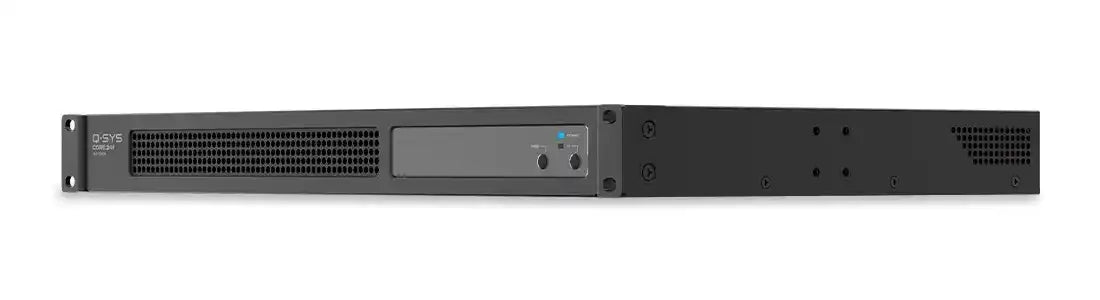
| Form Factor | 1U full-width rack-mount |
| Certifications | FCC, CE, UL, RoHS, RCM, WEEE, China RoHS |
| SKU | CORE 24f |
Competitor Comparison
| Criteria | QSC Core 24f | Biamp Tesira SERVER-IO | Crestron AVIA DSP |
|---|---|---|---|
| Platform Architecture | Unified AV&C (Q-SYS Designer); audio, video, and control in one software environment; control engine included without core licenses | Modular card-based DSP server; requires Biamp Cornerstone for control integration | Audio DSP; separate Crestron control processor required for advanced control |
| Network Audio Channels | 160×160 Q-LAN/AES67 native | Dante or AES67 via expansion cards; channel count varies by card configuration | 64×64 Dante standard; AES67 not native |
| Analog I/O | 24 total; 8 software-definable Flex channels | Card-based; flexible but each card type purchased separately | 16 fixed mic/line inputs, 16 fixed outputs |
| AEC Channels | 24 standard (no license required) | 8 per AEC card; additional cards required for more channels | 16 standard (fixed) |
| USB AV Bridging | Native 16×16 via USB-C, 24-bit quality; up to 3 simultaneous device connections | No native USB bridging; external device required | No native USB bridging |
| VoIP | Up to 8 native softphone instances | 1–2 via VoIP card; additional hardware needed for more | 1–2 instances; external SIP gateway often required |
| Control Engine | Full Q-SYS Control engine included; UCI, scripting, GPIO, and RS-232 device control without core feature licenses | Requires separate Biamp Cornerstone platform | Requires Crestron control processor (CP4 or similar) |
| Network Ports | 4× 2.5 Gbps (2 multimedia + 2 auxiliary) | 1Gbps standard; expansion cards for more | 1Gbps standard |
| Media Storage | 128 GB onboard; multitrack playback/record included | No onboard media storage | No onboard media storage |
| Price Point (MSRP) | $5,400 | ~$6,000–$9,000+ (chassis + cards) | ~$5,000–$7,000 (configuration-dependent) |
What's in the Box
- QSC Core 24f processor
- Removable rack ears
- IEC AC mains power cord
- I/O connector kit
- Regulatory statements pamphlet
- Warranty statement
Frequently Asked Questions
Is the Core 24f a direct replacement for the Core 110f V2?
Yes. QSC designated the Core 24f as the successor to the Core 110f line. It offers more AEC channels (24 vs. 16), more network audio capacity (160×160 vs. 128×128), higher-resolution USB-C bridging (24-bit vs. 16-bit), four 2.5 Gbps network ports vs. two 1 Gbps ports, and double the VoIP capacity (8 vs. 4). Existing Q-SYS Designer configurations from Core 110f deployments can be migrated to the Core 24f within the same software environment.
Does the Core 24f require feature licenses for the control engine?
No — this is a key differentiator from the Core 110f series. The full Q-SYS Control engine, including UCI deployment, scripting, GPIO control, RS-232 device control, and third-party IP integration, is included without requiring core feature licenses. Optional add-on licenses are still available for Microsoft Teams Room integration, expanded Dante channels, and multi-track playback expansion.
How many Q-SYS peripherals can the Core 24f support?
Up to 96 network peripherals, including TSC-50-G3, TSC-70-G3, and TSC-101-G3 touch panels, NC Series PTZ and ePTZ cameras, NM-T1 microphones, QIO I/O expanders, NV Series video endpoints, and CX-Q network amplifiers.
What Dante channel capacity is included, and how can it be expanded?
The Core 24f includes 8×8 software-based Dante channels. Capacity can be licensed up to 64×64 via Q-SYS Software-based Dante licenses available from Creation Networks. This is a significant increase over the Core 110f V2's maximum of 32×32.
Can the Core 24f handle multi-track audio recording and playback?
Yes. The onboard 128 GB media drive supports 4-channel simultaneous recording and 16-channel playback out of the box. Playback capacity is expandable to 64 channels with an optional multi-track playback license. The drive holds approximately 200+ hours of uncompressed mono WAV audio at 48 kHz/24-bit.
What warranty and support does Creation Networks provide for the Core 24f?
The QSC Core 24f carries QSC's standard 3-year limited warranty. Creation Networks provides pre-sales system design support, Q-SYS Designer configuration consultation, and post-sale technical support. Contact us at creationnetworks.net.
At Creartion Networks, we do everything we can to create an excellent customer experience. This includes fast shipping and easy returns.
- Most in-stock orders placed Monday-Friday ship within 24-48 hours. General restrictions apply; please see our full shipping policy here.
- We offer a 30-day return policy from the delivery date on many products. Product restrictions apply. Restocking fees for the return of open-box items. Please see our full return policy here for more information.
Nationwide Audiovisual Services, Design, Installation & Support
Creation Networks is a trusted nationwide partner for complete audiovisual solutions — delivering expert AV system sales, professional design, programming, installation, and ongoing support to organizations across the United States.
From Microsoft Teams Rooms and enterprise video conferencing to LED video walls, live streaming production, and hybrid collaboration systems, we provide end-to-end AV integration using premium, certified technology from industry leaders including Crestron, Q-SYS, Shure, Extron, and Absen.
Whether you operate a single location or manage facilities nationwide, Creation Networks ensures your AV systems are designed for reliability, scalability, security, and long-term performance — helping your organization communicate more effectively and operate at peak efficiency.
CREATION NETWORKS — A PARTNER YOU CAN TRUST SINCE 2006


