
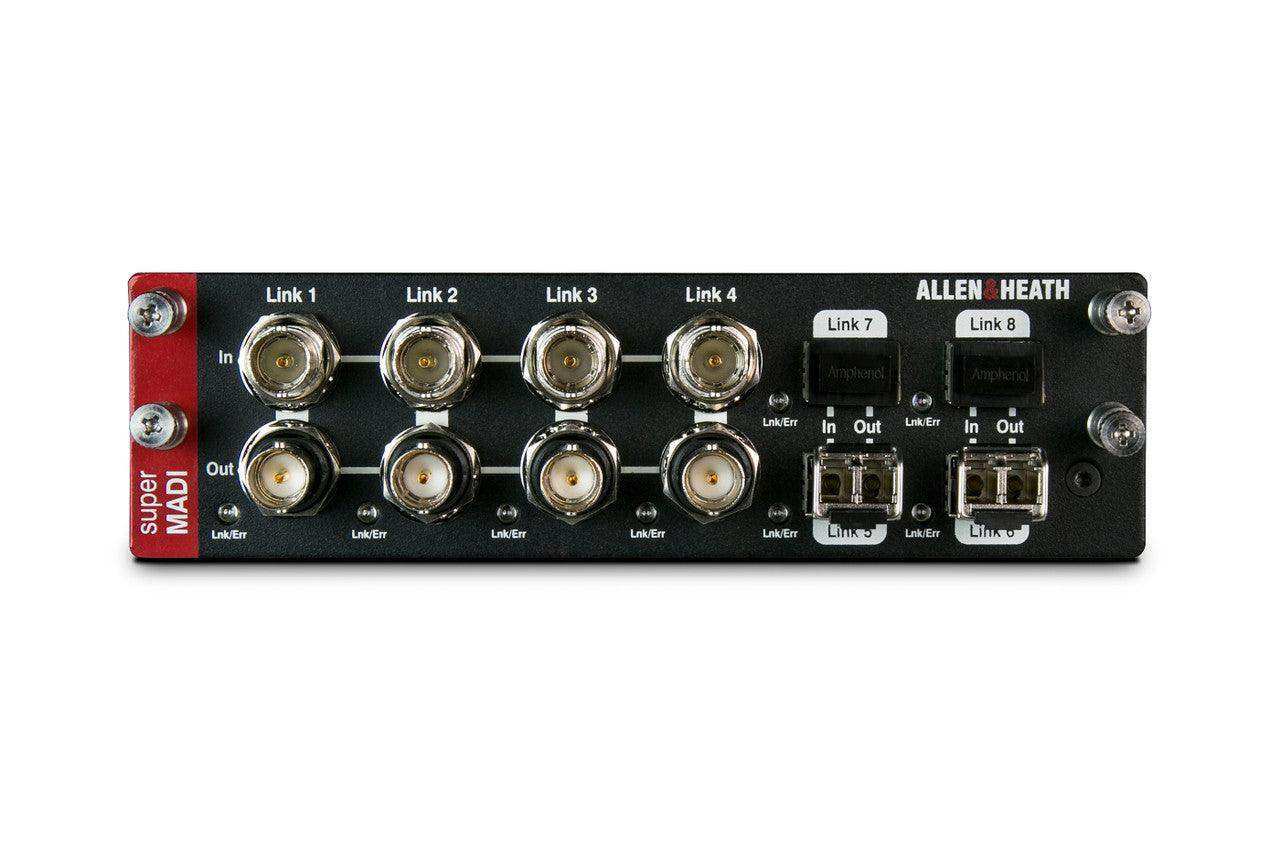
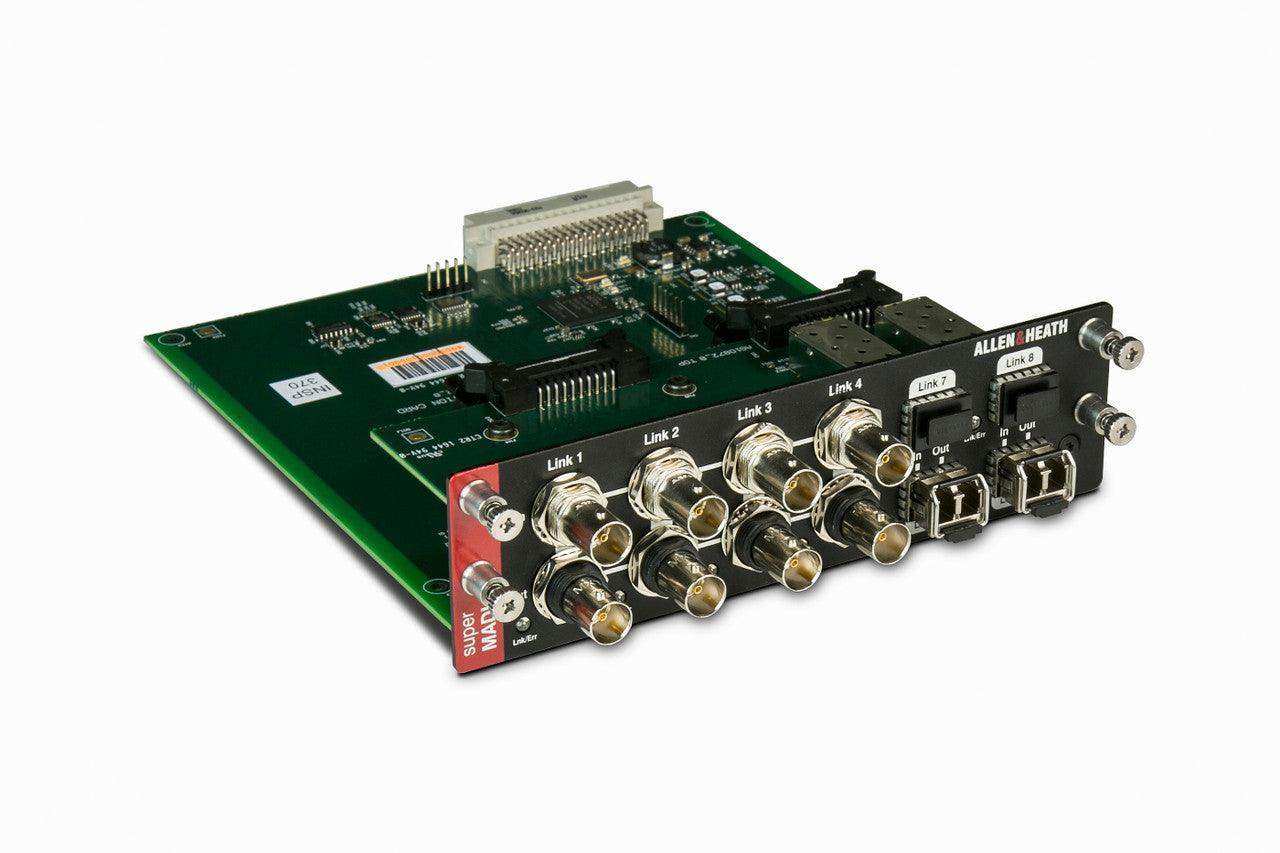

Allen & Heath AH-M-DL-SMADI2-A 4 MADI links via BNC and SFP, 128 x 128 96kHz MADI card

Allen & Heath AH-M-DL-SMADI2-A 4 MADI links via BNC and SFP, 128 x 128 96kHz MADI card is backordered and will ship as soon as it is back in stock.
Shipping Availability*
Shipping Availability*
Free Ground Shipping on Most Orders Over $250.00
Looking for the best price or expert advice? Give us a call at 1-888-230-3661 or use the Live Chat below. Buying 1 or 100, you may qualify for greater savings beyond the advertised price.

Allen & Heath AH-M-DL-SMADI2-A 4 MADI links via BNC and SFP, 12...
Allen & Heath AH-M-DL-SMADI2-A – 4-Link MADI Card with BNC/SFP, 128x128 at 96 kHz
Product Overview
The Allen & Heath AH-M-DL-SMADI2-A superMADI card is a high-density MADI audio networking expansion module for dLive and Avantis mixing systems, providing four MADI links via eight BNC connectors and eight SFP slots (optical modules not included). At 96 kHz, both coaxial and optical formats deliver up to 128 bidirectional channels simultaneously, with per-link-pair switchable sample rates (48 kHz or 96 kHz) and switchable redundancy. As a professional MADI expansion card for dLive and Avantis in broadcast, recording, and large-scale live production, the superMADI card provides a critical connectivity bridge between Allen & Heath digital consoles and the extensive installed base of MADI-enabled third-party equipment. Engineers and rental companies rely on the AH-M-DL-SMADI2-A to create high-channel-count digital audio splits between FOH and monitor positions without analog cable runs.
Product Description
The AH-M-DL-SMADI2-A installs into any I/O option port on Allen & Heath dLive or Avantis systems, providing four independent MADI links. Eight BNC connectors handle coaxial MADI at up to 128 channels at 96 kHz, while eight SFP slots accept standard optical transceiver modules (not included) for long-distance fiber-optic MADI transmission. Both formats operate simultaneously, giving system designers maximum flexibility in infrastructure.

Sample rate is switchable per link pair (48 kHz or 96 kHz), and the card supports both Smux and HighSpeed 96 kHz modes, providing compatibility with the broadest range of MADI endpoints. Redundancy is switchable per link pair, enabling primary/secondary path protection on critical connections while leaving non-critical links in standard mode to maximize channel capacity. This per-pair configurability allows complex multi-destination MADI architectures within a single card installation.

The superMADI card enables dLive and Avantis systems to interface with any MADI-enabled third-party console, recorder, broadcast router, or signal processor, opening integration pathways that Dante or proprietary networking cards cannot address. This makes the SMADI2 card particularly valuable in broadcast trucks, recording studios, and large festival productions where MADI infrastructure is already established.
Key Features
- 4 MADI Links via BNC and SFP — 8x BNC coaxial connectors and 8x SFP optical slots (modules not included) for simultaneous coaxial and fiber MADI I/O
- 128x128 at 96 kHz — Up to 128 bidirectional channels on both coaxial and optical formats at 96 kHz sample rate
- Switchable Sample Rate per Link Pair — Independent 48 kHz or 96 kHz selection per link pair for mixed-rate architectures
- Switchable Redundancy per Pair — Per-link-pair primary/secondary redundancy for critical signal paths
- Smux and HighSpeed 96 kHz Mode Support — Compatibility with the full range of MADI endpoint devices
- dLive and Avantis Compatibility — Fits any I/O option slot on Allen & Heath dLive and Avantis mixing systems
- Third-Party Console Interfacing — Digital audio splits to any MADI-enabled console, recorder, or processor
- Broadcast and Recording Integration — Purpose-built for environments where MADI infrastructure is the established standard
Typical Applications
- dLive and Avantis commercial installation connecting to MADI-based broadcast routers or recorders
- Large-scale live production with FOH/monitor digital audio splits via MADI
- Broadcast trucks and OB vans using dLive or Avantis with existing MADI signal paths
- Recording studios interfacing Allen & Heath consoles with MADI-connected recording systems
- Festival productions where rental MADI infrastructure interconnects multiple console brands
Technical Specifications
| Compatibility | Allen & Heath dLive and Avantis (I/O option port) |
| BNC Connectors | 8x BNC (4 coaxial MADI links) |
| SFP Slots | 8x SFP (optical modules not included) |
| Channel Count (Coaxial) | 128 Bidirectional at 96 kHz |
| Channel Count (Optical) | 128 Bidirectional at 96 kHz |
| Sample Rate | 48 kHz or 96 kHz, switchable per link pair |
| 96 kHz Mode | Smux or HighSpeed (switchable) |
| Redundancy | Switchable per link pair |
| Number of MADI Links | 4 |
Frequently Asked Questions
- Which consoles accept the AH-M-DL-SMADI2-A?
- The superMADI card fits any I/O option port on Allen & Heath dLive (C-Class and S-Class) and Avantis mixing systems.
- Are the SFP optical modules included with the card?
- No. SFP optical transceiver modules are not included and must be purchased separately. The card accepts standard SFP modules; consult Allen & Heath's documentation for recommended module specifications.
- What is the difference between Smux and HighSpeed 96 kHz mode?
- Smux multiplexes two 48 kHz MADI streams to achieve 96 kHz operation and is compatible with a wider range of legacy MADI devices. HighSpeed mode transmits native 96 kHz audio and is supported by newer MADI equipment. The choice depends on the capabilities of connected third-party devices.
- Can coaxial and optical MADI be used simultaneously?
- Yes. The BNC and SFP connections operate simultaneously, allowing coaxial MADI to one destination and optical fiber MADI to another from the same card.
- Can the superMADI card interface with non-Allen & Heath consoles?
- Yes. The MADI protocol is an open industry standard (AES10). The superMADI card can interface with any MADI-enabled console, recorder, processor, or router from any manufacturer, making it ideal for multi-console deployments and rental environments.
- What does switchable redundancy per link pair mean?
- Each pair of MADI links can independently operate in redundant (primary/backup) mode or as separate independent links. This allows critical signal paths to have failover protection while other links are used to maximize total channel count.
- How many total MADI channels does this card provide?
- The card provides up to 128 bidirectional channels on coaxial and up to 128 bidirectional channels on optical, for a total potential of 256 bidirectional channels when both formats are used simultaneously at 96 kHz.
At Creartion Networks, we do everything we can to create an excellent customer experience. This includes fast shipping and easy returns.
- Most in-stock orders placed Monday-Friday ship within 24-48 hours. General restrictions apply; please see our full shipping policy here.
- We offer a 30-day return policy from the delivery date on many products. Product restrictions apply. Restocking fees for the return of open-box items. Please see our full return policy here for more information.
Nationwide Audiovisual Services, Design, Installation & Support
Creation Networks is a trusted nationwide partner for complete audiovisual solutions — delivering expert AV system sales, professional design, programming, installation, and ongoing support to organizations across the United States.
From Microsoft Teams Rooms and enterprise video conferencing to LED video walls, live streaming production, and hybrid collaboration systems, we provide end-to-end AV integration using premium, certified technology from industry leaders including Crestron, Q-SYS, Shure, Extron, and Absen.
Whether you operate a single location or manage facilities nationwide, Creation Networks ensures your AV systems are designed for reliability, scalability, security, and long-term performance — helping your organization communicate more effectively and operate at peak efficiency.
CREATION NETWORKS — A PARTNER YOU CAN TRUST SINCE 2006


