
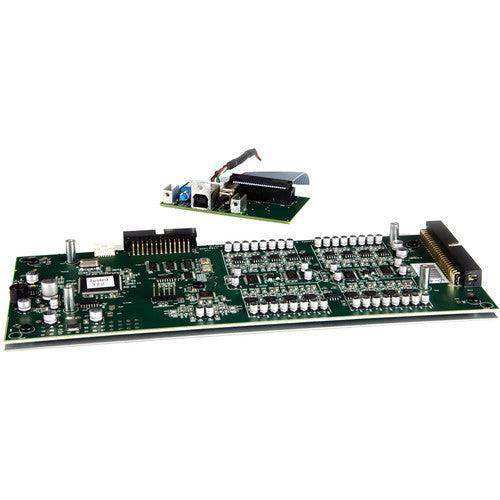

Allen & Heath AH-W4-USB Audio Option for MixWizard4 Mixers

Allen & Heath AH-W4-USB Audio Option for MixWizard4 Mixers is backordered and will ship as soon as it is back in stock.
Shipping Availability*
Shipping Availability*
Free Ground Shipping on Most Orders Over $250.00
Looking for the best price or expert advice? Give us a call at 1-888-230-3661 or use the Live Chat below. Buying 1 or 100, you may qualify for greater savings beyond the advertised price.

Allen & Heath AH-W4-USB Audio Option for MixWizard4 Mixers
Allen & Heath AH-W4-USB – USB Audio Option for MixWizard4 Mixers
Product Overview
The Allen & Heath AH-W4-USB is a plug-in audio option card that upgrades any MixWizard4 (WZ4) mixer with direct USB computer connectivity, eliminating the need for an external audio interface. The card mounts neatly inside the rear pod of the mixer and presents a USB 2.0 port at the mixer's rear panel, keeping the installation clean and cable-managed. With 16 channels of audio routed to the computer for recording or processing, plus a stereo return path for monitoring and effects, the W4-USB transforms an analog WZ4 console into a hybrid digital production hub. Routing options are selected via switches flanking the USB connector, giving engineers immediate control without menu navigation.
Product Description
The AH-W4-USB is the factory-approved expansion card for Allen & Heath's MixWizard4 series, purpose-built to integrate directly into the mixer's internal architecture rather than tapping signals at the patchbay. This internal approach preserves signal integrity, eliminates additional converter boxes on the stagebox or FOH rack, and keeps the console footprint unchanged — a significant advantage in space-constrained environments.

Operating at sample rates from 44.1 kHz up to 96 kHz at 24-bit resolution, the card delivers professional audio fidelity suitable for multitrack recording and broadcast applications. The 16-channel send path captures individual channel signals, bus outputs, or a combination determined by the WZ4's internal routing, providing the flexibility to record stems, isolated tracks, or a combined mix simultaneously.
The stereo return channel feeds back from the computer into the mixer's monitoring section, enabling real-time software effects, virtual instruments, or DAW playback to be incorporated into the live mix or monitor mix without additional hardware. This bidirectional workflow is particularly valuable in houses of worship, broadcast facilities, and recording studios where the same console serves both live reinforcement and recording duties.
Installation requires no tools beyond what is needed to access the WZ4 rear pod. The card slots into the designated expansion bay and is recognized immediately by Windows and macOS without third-party drivers for basic operation, reducing setup time during critical pre-show or pre-session periods. The USB 2.0 interface provides sufficient bandwidth for all 16 channels at supported sample rates.
Measured performance figures confirm professional-grade analog front-end quality: THD+N of 0.007% at 1 kHz with a +10 dBu signal, frequency response within +0.25/-0.5 dB across 20 Hz to 20 kHz, and headroom of 19 dB analog from nominal. These specifications align with the WZ4's analog signal path, ensuring the digital conversion does not become the weakest link in the signal chain.
Key Features
- Internal card installation — mounts inside the WZ4 rear pod for a clean, integrated result with no external converters required
- 16-channel USB send — routes up to 16 channels of audio to the connected computer for recording or DAW processing
- Stereo USB return — accepts a stereo feed from the computer for monitoring, effects, or playback integration
- Multi-rate operation — supports 44.1, 48, 88.2, and 96 kHz sample rates at 24-bit resolution
- USB 2.0 connectivity — standard USB-B port at the rear panel; plug-and-play on Windows and macOS
- Routing switches — hardware switches on either side of the USB port allow fast routing configuration changes
- Low distortion — 0.007% THD+N at 1 kHz ensures transparent conversion
- Broad OS compatibility — supports Windows XP through 8 (32/64-bit) and macOS 10.5 through 10.8
Typical Applications
- Live sound recording — capture multitrack recordings of live performances directly from the WZ4 console without an external interface
- Broadcast production — route audio to a workstation for live mixing, delay buffers, or on-air processing
- House of worship — record services for archiving, podcast distribution, or livestreaming with a single USB cable
- Recording studio — use the WZ4 as a hybrid analog/digital console feeding a DAW
- MixWizard4 system upgrades — extend the capabilities of existing WZ4 installations without replacing the console
Technical Specifications
| Parameter | Specification |
|---|---|
| Sample Rates | 44.1 / 48 / 88.2 / 96 kHz |
| Bit Depth | 24-bit |
| USB Send Channels | 16 |
| USB Return Channels | 2 (stereo) |
| Interface | USB 2.0 |
| THD+N | 0.007% @ 1 kHz, +10 dBu, 48 kHz |
| Frequency Response | +0.25 / -0.5 dB, 20 Hz – 20 kHz |
| Analog Headroom (from nominal) | 19 dB |
| Digital Headroom (from nominal) | 20 dB |
| Compatibility | MixWizard4 (WZ4) series only |
| OS Support | Windows XP–8 (32/64-bit), macOS 10.5–10.8 |
Frequently Asked Questions
- Which Allen & Heath mixers is the AH-W4-USB compatible with?
- The W4-USB is designed exclusively for the MixWizard4 (WZ4) series. It will not fit other Allen & Heath consoles.
- Does the card require drivers to function?
- On Windows and macOS systems within the supported range, the card operates as a class-compliant USB device. No third-party driver installation is necessary for basic recording and playback.
- How many channels can be recorded simultaneously?
- The card sends 16 channels to the connected computer simultaneously, along with a stereo return from the computer to the mixer.
- Can the W4-USB be used for live streaming or broadcast?
- Yes. The card routes audio directly to any DAW or broadcast software on the connected computer, making it suitable for livestreaming, podcast recording, and broadcast applications.
- Is professional installation required?
- The card slots into the WZ4 rear pod expansion bay. While no specialized tools are required, users unfamiliar with electronics should have the card installed by a qualified AV technician.
- What sample rate should I use for broadcast applications?
- 48 kHz is the standard for broadcast and video production. The card also supports 44.1 kHz for music recording, and 88.2/96 kHz for high-resolution audio workflows.
- Can I use the stereo return for software effects processing?
- Yes. The stereo return channel can feed effects plug-ins running on the connected computer back into the mixer's monitoring section, enabling a hybrid software/hardware effects workflow.
At Creartion Networks, we do everything we can to create an excellent customer experience. This includes fast shipping and easy returns.
- Most in-stock orders placed Monday-Friday ship within 24-48 hours. General restrictions apply; please see our full shipping policy here.
- We offer a 30-day return policy from the delivery date on many products. Product restrictions apply. Restocking fees for the return of open-box items. Please see our full return policy here for more information.
Nationwide Audiovisual Services, Design, Installation & Support
Creation Networks is a trusted nationwide partner for complete audiovisual solutions — delivering expert AV system sales, professional design, programming, installation, and ongoing support to organizations across the United States.
From Microsoft Teams Rooms and enterprise video conferencing to LED video walls, live streaming production, and hybrid collaboration systems, we provide end-to-end AV integration using premium, certified technology from industry leaders including Crestron, Q-SYS, Shure, Extron, and Absen.
Whether you operate a single location or manage facilities nationwide, Creation Networks ensures your AV systems are designed for reliability, scalability, security, and long-term performance — helping your organization communicate more effectively and operate at peak efficiency.
CREATION NETWORKS — A PARTNER YOU CAN TRUST SINCE 2006


