
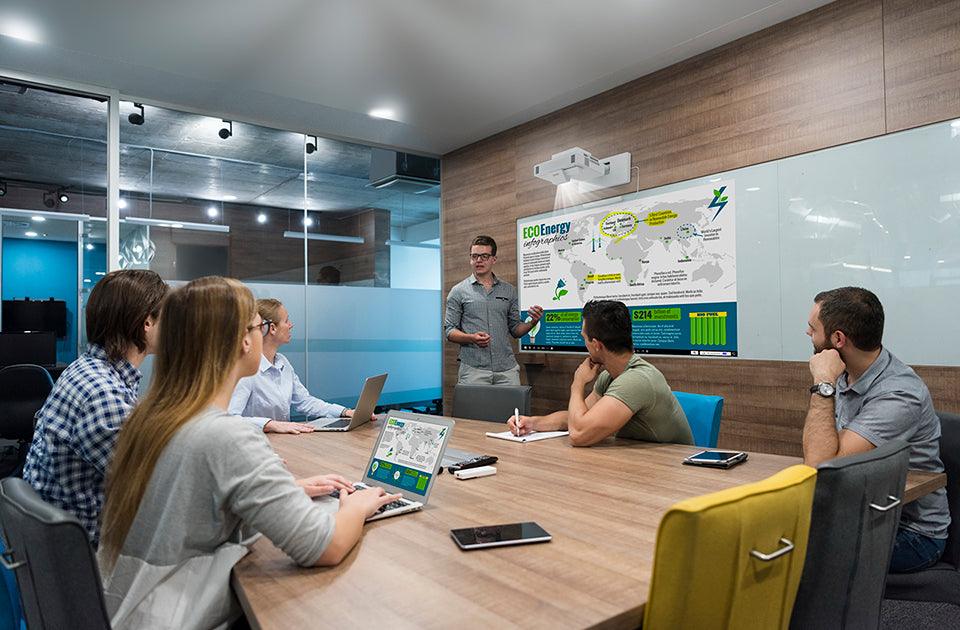
Flat panels took over conference rooms years ago, but laser and LED projectors, especially short-throw and ultra-short-throw models, are a real option again. The right choice depends on image size, room light, and whether people need to touch the screen.
Quick answer: Choose a flat-panel display for most small and medium conference rooms, any room with lots of daylight, and anywhere people need touch or whiteboarding. Choose a short-throw or ultra-short-throw laser projector when you need a very large image (100 inches and up) on a budget, in a room where you can control the light. For big, bright, premium rooms, direct-view LED is the third option.

Projector or flat panel: side by side
| Factor | Flat-panel display | Short / ultra-short-throw projector |
|---|---|---|
| Image size | Common up to about 98–110 in. | 100–150 in. and up |
| Bright rooms | Strong | Weaker; needs light control or an ambient-light-rejecting screen |
| Touch / whiteboarding | Excellent on interactive panels | Limited |
| Cost per inch at large sizes | High | Lower |
| Weight and mounting | Heavy at large sizes; needs wall backing | Light projector plus a screen |
| Maintenance | Minimal | Minimal with laser or LED; lamps need replacing |
What is a short-throw projector?
Throw distance is how far the projector sits from the screen for a given image size. A standard projector hangs well back in the room. A short-throw model sits a few feet away, and an ultra-short-throw model sits inches from the wall, usually mounted just above or below the image. Being close means presenters don't walk through the beam or get light in their eyes, and you get fewer shadows.
Ultra-short-throw projectors are handy in tight rooms where a ceiling mount isn't possible but you still want a 100-inch image.

Lamp, laser, or LED?
- Lamp: The lowest upfront cost, but the lamps dim and need replacing, and the filters need cleaning. Avoid lamps in busy conference rooms.
- Laser: Bright and long-lasting with little maintenance. It's the usual choice for business rooms today.
- LED: Long life and compact, usually lower brightness than laser, and many units are sealed against dust.
Image quality: what matters
Treat 1080p as the minimum and 4K as the target, because a big projected image makes low resolution obvious. Color accuracy matters for presentations. Brightness has to beat the room's ambient light. In rooms with windows, pair the projector with an ambient-light-rejecting screen or choose a flat panel.
Which is right for your room?
- Huddle and small rooms: A flat panel, often with a video bar.
- Rooms where people annotate or whiteboard: An interactive flat panel.
- Large training rooms and classrooms with light control: A laser short-throw or ultra-short-throw projector for the biggest image per dollar.
- Bright boardrooms and lobbies: A flat panel, or direct-view LED for very large images.
For display sizing alongside camera and audio, see our pillar guide, Designing a Future-Proof Conference Room AV System. Browse Panasonic projectors or Epson projectors.
Frequently asked questions
Is a projector or a TV better for a conference room?
A flat panel is better for most conference rooms, especially bright ones or ones that need touch. A projector wins when you need a very large image on a budget and can control the room light.
What is the difference between short-throw and ultra-short-throw?
Both sit closer to the screen than a standard projector. Ultra-short-throw models sit just inches from the wall, while short-throw models sit a few feet away.
What resolution should a conference room projector have?
At least 1080p. 4K is better for detailed content and large images.
Do projectors work in rooms with windows?
Only with enough brightness and an ambient-light-rejecting screen, or with shades. Otherwise, choose a flat panel or direct-view LED.
Are laser projectors worth it over lamp projectors?
For business use, yes. Laser projectors need far less maintenance and hold their brightness longer.
Related Resources
- Designing a Future-Proof Conference Room AV System
- Direct View LED for Large Conference Rooms
- Video Conference Equipment: How to Spec by Room Size
- Conference Room AV Solutions
Creation Networks, Inc. — nationwide commercial AV integrator, CTS-D certified, headquartered in Incline Village, NV with a California office in Concord. Design, engineering, programming, installation, and support from a single point of contact since 2006. Call 888-230-3661 or email sales@creationnetworks.net.
Get Started
Projector or Display? We'll Help You Choose
Send us the room size, seating depth, and how much daylight it gets. A CTS-D engineer will recommend the right display, usually within one business day.


