
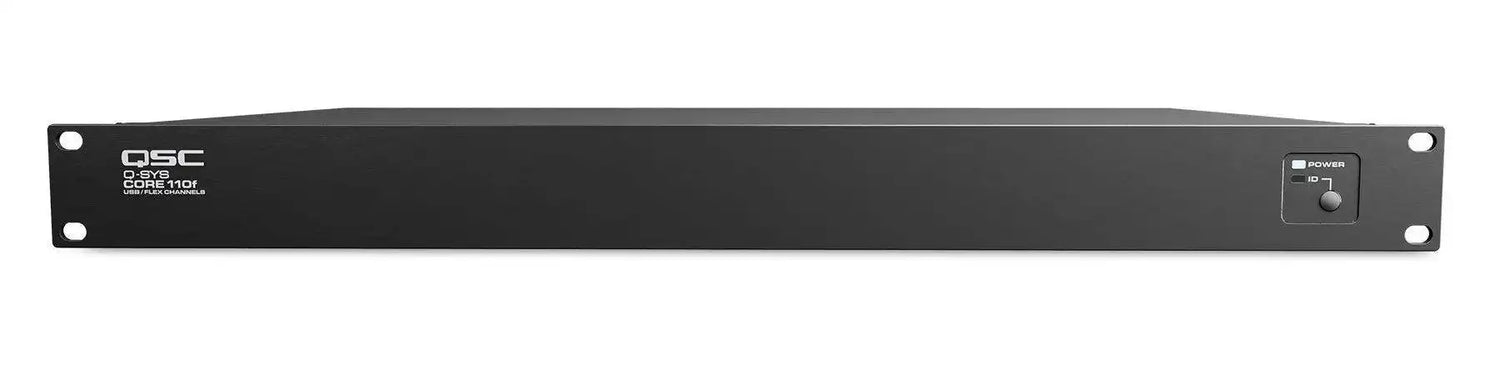

QSC Core 110f V2 – Q-SYS Network + Analog AV&C Processor (End of Life)

QSC Core 110f V2 – Q-SYS Network + Analog AV&C Processor (End of Life) is backordered and will ship as soon as it is back in stock.
Shipping Availability*
Shipping Availability*
Free Ground Shipping on Most Orders Over $250.00
Looking for the best price or expert advice? Give us a call at 1-888-230-3661 or use the Live Chat below. Buying 1 or 100, you may qualify for greater savings beyond the advertised price.

QSC Core 110f V2 – Q-SYS Network + Analog AV&C Processor (End o...

⚠️ End of Life Notice: The QSC Core 110f V2 reached end of life in December 2025. Stock is available while supplies last. The QSC Core 24f is the recommended replacement and current-generation successor in the Q-SYS Core processor lineup.
Product Overview
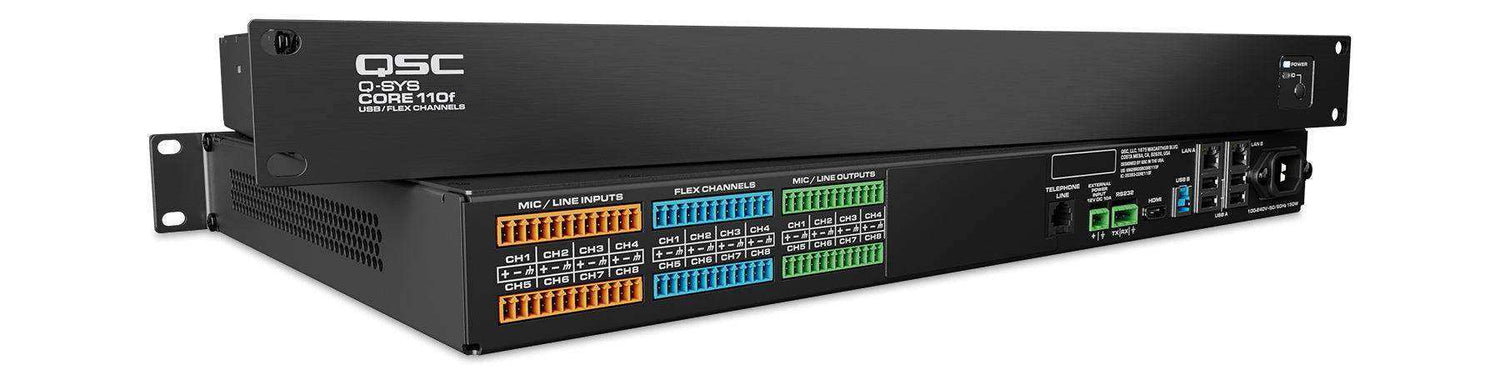
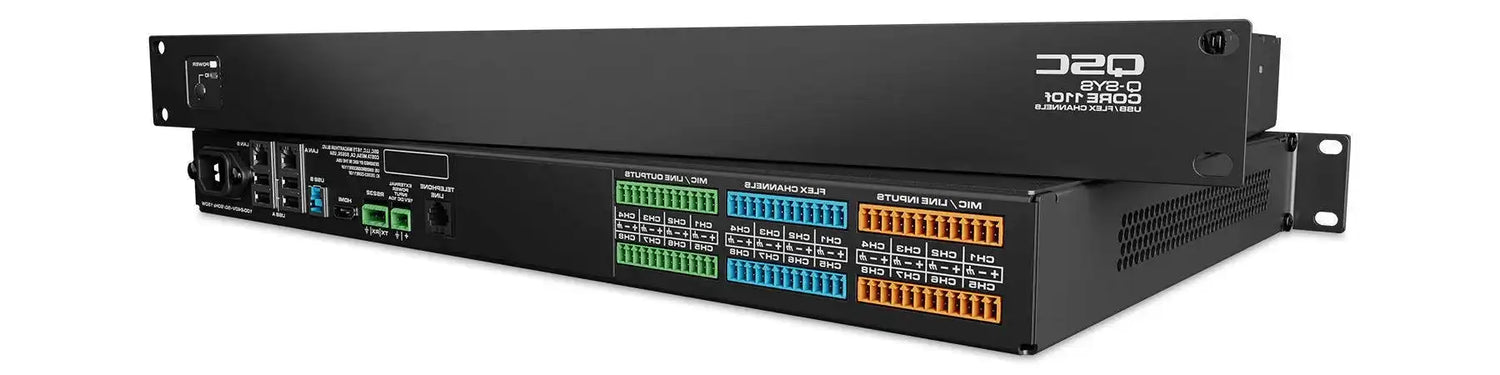
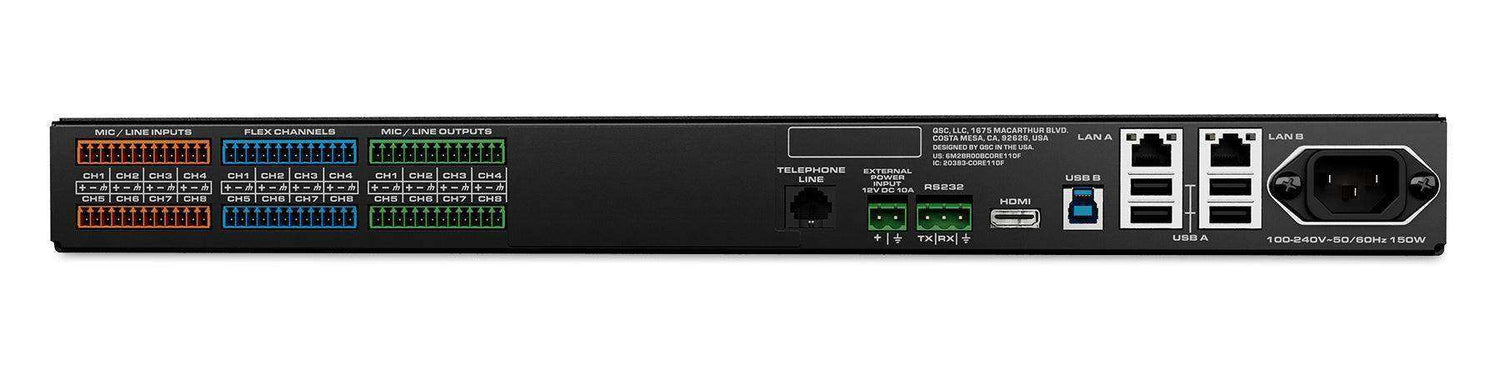
The QSC Core 110f V2 is a full 1U rack-mount Q-SYS audio, video, and control (AV&C) processor engineered for medium to large commercial AV deployments. It represents the highest I/O density in the Core 100-series lineup: 128×128 Q-LAN/AES67 networked audio channels, 24 analog I/O ports including 8 software-definable Flex channels, 16 channels of acoustic echo cancellation (AEC), and 16×16 USB AV bridging for UC platform integration. The V2 revision updates the hardware by removing GPIO and the front-panel OLED display to improve supply chain availability, while preserving all core audio, video, and control functionality.

Like all Q-SYS Core processors, the Core 110f V2 runs on Q-SYS Designer software, enabling integrators to design, configure, and manage the system using the same tool across the entire Q-SYS portfolio. Enterprise-grade IT features — including Layer 3 routing support, SNMP monitoring, LDAP integration, and encrypted firmware — make it suitable for IT-managed AV environments in corporate, government, and higher education settings. Optional QIO expansion modules extend analog I/O capacity as project requirements grow.
Key Features
- 128×128 Q-LAN/AES67 networked audio channels — Highest network channel capacity in the Core 100-series, supporting large distributed audio architectures across enterprise campuses.
- 24 analog I/O with 8 software-definable Flex channels — Flex channels are independently configurable as mic input, line input, or line output, providing card-like flexibility without custom hardware orders.
- 16 channels of acoustic echo cancellation (AEC) — Double the AEC capacity of the Core 8 Flex and Core Nano, suited for larger multi-mic conferencing and telepresence environments.
- 16×16 USB AV bridging + Q-SYS camera support — Native integration with Microsoft Teams, Zoom, Google Meet, and Cisco Webex without a separate USB bridge device.
- Software-based Dante (8×8 included, licensable to 32×32) — Dante interoperability with third-party networked audio devices across a shared IP infrastructure.
- Up to 4 VoIP softphone instances — Native SIP/PSTN telephony for enterprise environments requiring dual-line or multi-zone POTS integration.
- Enterprise IT integration — Layer 3 routing, SNMP monitoring, LDAP user management, AES-encrypted transport, and cryptographically signed firmware updates.
- Full Q-SYS Control engine — Third-party device control, scheduling, automation, and UCI-based user interfaces without a separate control processor.
- QIO expansion compatibility — Supports QIO-ML4i, QIO-L4o, QIO-ML2x2, QIO-S4, QIO-IR1x4, QIO-GP8x8, and other QIO peripherals to expand I/O without replacing the core processor.
- 1U full-width rack-mount — Standard 19" rack installation; internal power supply with 60W typical / 120W maximum consumption.
Typical Applications
- Boardroom
- Conference room (medium to large)
- House of worship
- Government space
- Commercial meeting space
- Multi-purpose room
- All-hands room
- Training room
- Higher education AV deployment
- Auditorium
Technical Specifications
| Specification | Value |
|---|---|
| Q-LAN / AES67 Channels | 128 × 128 |
| Dante Channels | 8×8 included; licensable to 32×32 |
| Analog I/O | 24 total; 8 software-definable Flex channels |
| AEC Processors | 16 |
| USB AV Bridging | 16×16 audio + Q-SYS camera support |
| VoIP Instances | Up to 4 |
| Input Frequency Response | 20 Hz – 20 kHz @ +21 dBu |
| Input THD+N | <0.0006% |
| Dynamic Range | Up to 109.5 dB |
| Output THD | 0.003% |
| Sample Rate | 48 kHz |
| IT Features | Layer 3 routing, SNMP, LDAP, AES-encrypted transport, signed firmware |
| Power Consumption | 60W typical / 120W maximum |
| Thermal Load | 205 BTU/hr |
| Dimensions (H×W×D) | 1.75" × 19" × 11.12" |
| Weight | 11 lbs (shipping: 12.4 lbs) |
| Form Factor | 1U full-width rack-mount |
| Certifications | FCC, CE, UL, RoHS, RCM, EAC |
| SKU | CORE-110f-v2 |
Competitor Comparison
| Criteria | QSC Core 110f V2 | Biamp Tesira SERVER-IO | Crestron AVIA DSP |
|---|---|---|---|
| Platform Architecture | Unified AV&C platform (Q-SYS Designer); audio, video, and control in one software environment | Modular card-based DSP server; separate Biamp Cornerstone control layer required | Audio DSP with Crestron control integration; separate programming environment for control logic |
| Network Audio Channels | 128×128 Q-LAN/AES67 native | Dante or AES67 via expansion cards; channel count varies by card configuration | 64×64 Dante standard; AES67 not native |
| Analog I/O | 24 total; 8 software-definable Flex channels | Card-based; flexible but requires physical card purchases per I/O type | 16 mic/line inputs, 16 outputs (fixed) |
| AEC Channels | 16 standard | 8 per AEC card; expandable with additional cards | 16 standard (fixed) |
| USB AV Bridging | Native 16×16 + Q-SYS camera routing included | No native USB bridging; external device required | No native USB bridging |
| VoIP | Up to 4 native softphone instances | Requires VoIP card; 1–2 instances typical | 1–2 instances; external SIP gateway often required |
| IT Integration | Layer 3 routing, SNMP, LDAP, encrypted transport | SNMP only; limited IT management features | Crestron ecosystem; SNMP and Crestron XiO Cloud monitoring |
| Control Engine | Full Q-SYS Control engine; UCI, scripting, and third-party device control included | Requires Biamp Cornerstone control platform separately | Requires Crestron control processor (CP4 or similar) for advanced control |
| Price Point (MSRP) | $5,100 | ~$6,000–$9,000+ (chassis + cards) | ~$5,000–$7,000 (configuration-dependent) |
What's in the Box
- QSC Core 110f V2 processor
- Rack-mount hardware (1U full-width)
- IEC power cord
- Quick-start documentation
Downloads
Spec Sheet (PDF) | User Manual (PDF)
Frequently Asked Questions
What changed between the Core 110f and the Core 110f V2?
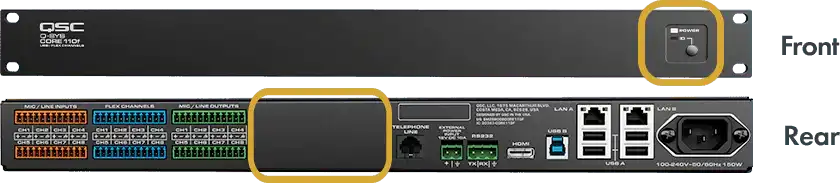
The V2 revision removes the front-panel GPIO ports and OLED display present on the original Core 110f. All audio processing, networking, AEC, USB bridging, VoIP, and control engine functionality is identical. The hardware revision was made to improve component availability during supply chain disruptions. If your design required GPIO at the processor, QSC's QIO-GP8x8 GPIO expander provides equivalent functionality as a network peripheral.
The Core 110f V2 is End of Life — should I still specify it?
Stock is available while supplies last. For new designs starting in 2025 or later, we recommend specifying the QSC Core 24f, which is the current-generation replacement. For existing installations already running Core 110f hardware, the V2 remains a valid spare or expansion processor. Contact our team for stock availability and migration guidance.
How does the Core 110f V2 compare to the Core 8 Flex and Core Nano?
The Core 110f V2 offers significantly more I/O density and processing headroom: 128×128 vs. 64×64 network audio channels, 16 AEC channels vs. 8, 16×16 USB bridging vs. 8×8, and 24 analog ports vs. 8 Flex channels (Core 8 Flex) or none (Core Nano). It is designed for medium-to-large deployments where the entry-level processors would be undersized. Compare all Core processors at creationnetworks.net/collections/qsc.
What optional licenses are available for the Core 110f V2?
Available licenses include: UCI Deployment License, Scripting Engine License, Microsoft Teams Room License, and software-based Dante licenses for 16×16 and 32×32 channel expansion. The Media Drive Kit (MD-110) adds multi-track recording and playback capability.
Can the Core 110f V2 be expanded with QIO modules?
Yes. The Core 110f V2 supports the full QIO peripheral range, including QIO-ML4i (4 mic/line inputs), QIO-L4o (4 line outputs), QIO-S4 (RS-232), QIO-IR1x4 (infrared), and QIO-GP8x8 (GPIO), all connecting via Q-LAN without additional licensing.
What warranty and support is available?
The QSC Core 110f V2 carries QSC's standard 3-year limited warranty. Creation Networks provides pre-sales design support, system configuration guidance, and post-sale technical assistance. Given the EOL status, we recommend confirming available stock with our team before finalizing project specifications. Contact us at creationnetworks.net.
At Creartion Networks, we do everything we can to create an excellent customer experience. This includes fast shipping and easy returns.
- Most in-stock orders placed Monday-Friday ship within 24-48 hours. General restrictions apply; please see our full shipping policy here.
- We offer a 30-day return policy from the delivery date on many products. Product restrictions apply. Restocking fees for the return of open-box items. Please see our full return policy here for more information.
Nationwide Audiovisual Services, Design, Installation & Support
Creation Networks is a trusted nationwide partner for complete audiovisual solutions — delivering expert AV system sales, professional design, programming, installation, and ongoing support to organizations across the United States.
From Microsoft Teams Rooms and enterprise video conferencing to LED video walls, live streaming production, and hybrid collaboration systems, we provide end-to-end AV integration using premium, certified technology from industry leaders including Crestron, Q-SYS, Shure, Extron, and Absen.
Whether you operate a single location or manage facilities nationwide, Creation Networks ensures your AV systems are designed for reliability, scalability, security, and long-term performance — helping your organization communicate more effectively and operate at peak efficiency.
CREATION NETWORKS — A PARTNER YOU CAN TRUST SINCE 2006


